Vanya & Sonia & Masha & Spike Review
| Uncle Vanya | |
|---|---|
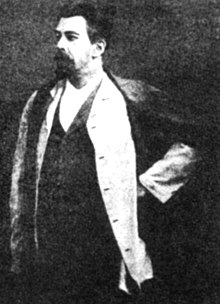 Konstantin Stanislavski as Astrov | |
| Written by | Anton Chekhov |
| Original language | Russian |
| Setting | Garden of the Serebryakov family estate |
Uncle Vanya (Russian: Дя́дя Ва́ня , tr. Dyádya Ványa , IPA: [ˈdʲædʲə ˈvanʲə]) is a play past the Russian playwright Anton Chekhov. It was starting time published in 1898, and was first produced in 1899 by the Moscow Fine art Theatre under the direction of Konstantin Stanislavski.
The play portrays the visit of an elderly professor and his glamorous, much younger 2d wife, Yelena, to the rural estate that supports their urban lifestyle. Two friends—Vanya, brother of the professor's tardily offset wife, who has long managed the manor, and Astrov, the local dr.—both autumn under Yelena's spell, while bemoaning the ennui of their provincial existence. Sonya, the professor's daughter by his commencement wife, who has worked with Vanya to keep the manor going, suffers from her unrequited feelings for Astrov. Matters are brought to a crisis when the professor announces his intention to sell the estate, Vanya and Sonya'southward domicile, with a view to investing the proceeds to achieve a higher income for himself and his married woman.
Background [edit]
Uncle Vanya is unique among Chekhov's major plays considering it is essentially an extensive reworking of his own play published a decade earlier, The Wood Demon.[i] By elucidating the specific changes Chekhov made during the revision process—these include reducing the cast from almost two dozen down to nine, changing the climactic suicide of The Wood Demon into the famous failed homicide of Uncle Vanya, and altering the original happy ending into a more ambiguous, less terminal resolution—critics such as Donald Rayfield, Richard Gilman, and Eric Bentley accept sought to chart the development of Chekhov's dramaturgical method through the 1890s.
Rayfield cites contempo scholarship suggesting Chekhov revised The Wood Demon during his trip to the island of Sakhalin, a prison colony in Eastern Russia, in 1891.
Characters [edit]
- Aleksandr Vladimirovich Serebryakov ( Алекса́ндр Влади́мирович Серебряко́в ): a retired university professor, who has lived for years in the city on the earnings of his late kickoff wife'due south rural estate, managed for him past Vanya and Sonya.
- Helena Andreyevna Serebryakova (Yelena) ( Еле́на Андре́евна Серебряко́ва ): Serebryakov's immature and beautiful second wife. She is 27 years quondam.
- Sofia Alexandrovna Serebryakova (Sonya) ( Со́фья Алекса́ндровна Серебряко́ва ): Serebryakov's daughter from his first spousal relationship. She is of a marriageable age, but is considered plain.
- Maria Vasilyevna Voynitskaya ( Мари́я Васи́льевна Войни́цкая ): the widow of a privy councilor and female parent of Vanya (and of Vanya's late sister, Serebryakov's beginning wife).
- Ivan Petrovich Voynitsky ("Uncle Vanya") ( Ива́н Петро́вич Войни́цкий ): Maria's son and Sonya's uncle, the title character of the play. He is 47 years quondam.
- Mikhail Lvovich Astrov ( Михаи́л Льво́вич А́стров ): a heart-aged country doctor. His preoccupation with the destruction of forests is one of the get-go discussions of ecological problems in world literature.
- Ilya Ilych Telegin ( Илья́ Ильи́ч Теле́гин ; nicknamed "Waffles" for his pockmarked peel): an impoverished landowner, who now lives on the manor as a dependent of the family.
- Marina Timofeevna ( Мари́на Тимофе́евна ): an old nurse.
- A Workman
Plot [edit]
Act I [edit]
A garden on Serebryakov'south country estate. Astrov and Marina discuss how old Astrov has grown and his boredom with his life equally a country medico. Vanya enters and complains of the disruption caused past the visit of the professor and his wife Yelena. As they're talking, Serebryakov, Yelena, Sonya, and Telegin return from a walk. Out of earshot of the professor, Vanya calls him "a learned one-time stale mackerel", criticizes his pomposity, and belittles his achievements. Vanya's mother, Maria Vasilyevna, who idolises Serebryakov, objects to her son's comments. Vanya also praises Yelena's youth and dazzler, arguing that faithfulness to an old human being similar Serebryakov is an immoral waste material of vitality. Astrov is forced to depart to attend a patient, simply not before delivering a speech on the preservation of the forests, a bailiwick he is very passionate about. Vanya declares his dearest to an exasperated Yelena.
Act II [edit]
The dining room, several days later, late at nighttime. Earlier going to bed, Serebryakov complains of hurting and old age. Astrov arrives, having been sent for past Sonya, but the professor refuses to encounter him. After Serebryakov falls asleep, Yelena and Vanya talk. She speaks of the discord in the house, and Vanya speaks of dashed hopes. He feels he'south misspent his youth and he associates his unrequited honey for Yelena with the disappointment of his life. Yelena refuses to listen. Alone, Vanya wonders why he did not fall in beloved with Yelena when he first met her x years before, when it would have been possible for the two of them to marry and have a happy life together. At that time, Vanya believed in Serebryakov'due south greatness and was happy that his efforts supported Serebryakov's work; he has since become disillusioned with the professor and his life feels empty. As Vanya agonises over his by, Astrov returns, somewhat boozer, and the two talk. Sonya chides Vanya for his drinking, and responds pragmatically to his reflections on the futility of a wasted life, pointing out that merely work is truly fulfilling.
Outside, a storm is gathering and Astrov talks with Sonya about the firm's suffocating atmosphere; he says Serebryakov is difficult, Vanya is a hypochondriac, and Yelena is charming but idle. He laments how long it has been since he loved anyone. Sonya begs Astrov to stop drinking, telling him it is unworthy of him to destroy himself. They discuss love, and it becomes clear that Sonya is in dearest with him and that he is unaware of her feelings.
When Astrov leaves, Yelena enters and makes peace with Sonya, later on an obviously long period of mutual animosity. Trying to resolve their difficulties, Yelena reassures Sonya that she had strong feelings for her male parent when she married him, though that love has proved illusory. The 2 converse at cantankerous purposes. Yelena confesses her unhappiness and Sonya gushes almost Astrov. In a happy mood, Sonya leaves to ask the professor if Yelena may play the piano. Sonya returns with his negative respond, which quickly dampens the mood.
Act III [edit]

Uncle Vanya at the Moscow Art Theatre (1899), Human activity Three
Vanya, Sonya, and Yelena are in the living room, having been called there by Serebryakov. Vanya calls Yelena a water nymph and urges her, once over again, to interruption free. Sonya complains to Yelena that she has loved Astrov for six years but that, because she is not cute, he doesn't detect her. Yelena volunteers to question Astrov and find out if he'south in dear with Sonya. Sonya is pleased, but before agreeing she wonders whether uncertainty is better than noesis, because then, at least, in that location is promise.
When Yelena asks Astrov near his feelings for Sonya, he says he has none and concludes that Yelena has brought up the subject of love to encourage him to confess his own feelings for her. Astrov kisses Yelena, and Vanya witnesses the embrace. Upset, Yelena begs Vanya to use his influence to allow her and the professor to leave immediately. Before Serebryakov tin can brand his announcement, Yelena tells Sonya that Astrov doesn't dearest her.
Serebryakov proposes to solve the family'southward financial bug by selling the manor and investing the proceeds in a bond which will bring in a significantly higher income (and, he hopes, get out enough over to purchase a villa for himself and Yelena in Finland). Angrily, Vanya asks where he, Sonya, and his mother would alive, protests that the manor rightly belongs to Sonya, and that Serebryakov has never appreciated his cocky-sacrifice in managing the property. As Vanya'south acrimony mounts, he begins to rage against the professor, blaming him for the failure of his life, wildly challenge that, without Serebryakov to hold him back, he could have been a second Schopenhauer or Dostoevsky. In despair, he cries out to his female parent, but instead of comforting her son, Maria insists that Vanya heed to the professor. Serebryakov insults Vanya, who storms out of the room. Yelena begs to exist taken away from the land and Sonya pleads with her male parent on Vanya's behalf. Serebryakov exits to confront Vanya further. A shot is heard from offstage and Serebryakov returns, being chased past Vanya, wielding a loaded pistol. He fires the pistol once more at the professor only misses. He throws the gun down in disgust and sinks into a chair.
Human action Iv [edit]
As the final act opens, a few hours subsequently, Marina and Telegin wind wool and discuss the planned divergence of Serebryakov and Yelena. When Vanya and Astrov enter, Astrov says that in this commune simply he and Vanya were "decent, cultured men" and that ten years of "narrow-minded life" have made them vulgar. Vanya has stolen a vial of Astrov's morphine, presumably to commit suicide; Sonya and Astrov beg him to render the narcotic, which he somewhen does.
Yelena and Serebryakov bid everyone bye. When Yelena says good day to Astrov, she admits to having been carried away by him, embraces him, and takes one of his pencils as a souvenir. Serebryakov and Vanya brand their peace, agreeing all will be as information technology was earlier. In one case the outsiders have departed, Sonya and Vanya pay bills, Maria reads a pamphlet, and Marina knits. Vanya complains of the heaviness of his heart, and Sonya, in response, speaks of living, working, and the rewards of the afterlife: "We shall hear the angels, we shall see the whole sky all diamonds, nosotros shall see how all earthly evil, all our sufferings, are drowned in the mercy that will fill up the whole world. And our life will grow peaceful, tender, sweet as a caress…. You've had no joy in your life; only await, Uncle Vanya, expect…. Nosotros shall remainder."
Productions [edit]
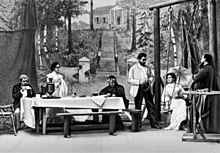
Although the play had previous small runs in provincial theatres in 1898, its metropolitan première took place on 7 November [O.South. 26 Oct] 1899 at the Moscow Art Theatre. Constantin Stanislavski played the part of Astrov while Chekhov's time to come wife Olga Knipper played Yelena. The initial reviews were favorable but pointed to defects in both the play and the acting. Equally the staging and the interim improved over successive performances, all the same, and as "the public understood better its inner meaning and nuances of feeling", the reviews improved.[two] Uncle Vanya became a permanent fixture in the Moscow Art Theatre.
Other actors who have appeared in notable stage productions of Uncle Vanya include Michael Redgrave, Paul Scofield, Peter O'Toole, Albert Finney, Franchot Tone, Cate Blanchett, Peter Dinklage, Jacki Weaver, Antony Sher, Ian McKellen, Richard Armitage, Simon Russell Beale, William Hurt, George C. Scott, Donald Sinden, Derek Jacobi, Michael Gambon, Tom Courtenay, Trevor Eve and Laurence Olivier.
The play was likewise adjusted as the new phase-play Dear Uncle by the British playwright Alan Ayckbourn, who reset it in the 1930s Lake Commune. This adaptation premiered from July to September 2011 at the Stephen Joseph Theatre.[3]
In January 2014 24/half dozen: A Jewish Theater Company performed TuBishVanya, a mod adaption that incorporated Jewish and ecology themes.[ citation needed ]
Parodies [edit]
- The Fifth Elephant, a 1999 novel by Terry Pratchett, includes a pastiche of Chekhov plays in which "the gloomy and purposeless trousers of Uncle Vanya" are loaned to Captain Vimes.[4]
- Life Sucks: Or the Present Ridiculous, a 2015 stage adaptation by Aaron Posner, premiered at Theater J in Washington, DC.[v]
- The Reduced Shakespeare Company performed a shortened version of the play on their BBC radio evidence in 2010 that contained only iii lines:[half-dozen]
"Are you Uncle Vanya?"
"I am."
[Gunshot sounds]
"Ouch!"
- Uncle Vanya and Zombies, a 2012 post-apocalyptic phase accommodation by Markus Wessendorf, premiered at Kennedy Theatre in Honolulu.[7] [8]
Other adaptations [edit]
Over the years, Uncle Vanya has been adapted for movie several times.
- Uncle Vanya, a 1957 adaptation of a concurrent Off-Broadway production that starred Franchot Tone, who co-produced and co-directed the film
- Uncle Vanya, a version of the star-studded 1962–63 Chichester Festival stage production, directed for the phase by Laurence Olivier, who played Astrov, and also starring Michael Redgrave equally Vanya, Max Adrian as Professor Serebryakov, Rosemary Harris equally Yelena and Olivier'due south wife Joan Plowright every bit Sonya. Harold Hobson of The Sunday Times described the Chichester production as "the admitted master achievement in British twentieth-century theatre" while The New Yorker called information technology "probably the best 'Vanya' in English we shall e'er see".[ix]
- Uncle Vanya, a 1970 Russian film version, adapted and directed by Andrei Mikhalkov-Konchalovsky.
- Uncle Vanya, a 1991 episode of the BBC Functioning anthology for Tv, starring Ian Holm and David Warner
- Vanya on 42nd Street, a 1994 American picture show version, adapted by David Mamet and directed by Louis Malle. It stars Wallace Shawn and Julianne Moore. Originally a little-known studio production, information technology was afterwards adapted for the screen, where it garnered wider acclaim.
- Country Life, a 1994 Australian adaptation, set in the Outback, starring Sam Neill every bit the equivalent of Astrov.
- August, a 1996 English motion picture adaptation, set in Wales, directed by and starring Anthony Hopkins in the Vanya role. Hopkins played Astrov in a BBC Play of the Month product in 1970.
- Sonya's Story, an opera adapted by director Sally Burgess, composer Neal Thornton and designer Charles Phu, portraying events in the play Uncle Vanya from the grapheme Sonya's perspective, premiered in 2010.
- Chekhov: Fast & Furious, a multimedia theatric performance project by the Franco-Austrian performance collective Superamas which translates the themes of the "former" theatre into our time. Premiered in 2018 at the Vienna Festival in Austria.[x]
- Uncle Vanya, a recording of the interrupted 2020 run at London'south Harold Pinter Theatre, adapted past Conor McPherson, starring Aimee Lou Woods, Rosalind Eleazar, Roger Allam, Toby Jones, and Richard Armitage. Due to the COVID-xix pandemic, it was decided to bring the cast dorsum under guidelines and flick the play for release in cinemas and later on the BBC.[11]
- Morbror Vanja, a Swedish language adaptation of the play, was performed at the Åbo Svenska Teater (Turku, Finland) in 2021.[12]
- Bulldoze My Auto, a 2021 film by Ryusuke Hamaguchi, includes a production of Uncle Vanya, with the characters echoing the emotional turmoil of Chekhov's characters as they reveal their trauma and deeply complicated feelings.[xiii]
Awards and nominations [edit]
- Awards
- 2003 Laurence Olivier Award for Best Revival
- Nominations
- 1992 Laurence Olivier Honor for Best Revival
- 2000 Drama Desk Honor Outstanding Revival of a Play
Encounter as well [edit]
- Chekhov's gun
References [edit]
- ^ Ryan McKittrick (2008). "Moscow'due south Offset Uncle Vanya: Checkhov and the Moscow Art Theatre". American Repertory Theatre. Archived from the original on 2008-06-19. Retrieved 2008-10-13 .
- ^ Simmons, Ernest (1962). Chekhov, A Biography . Boston: Trivial, Dark-brown and Company. p. 486.
- ^ Alfred Hickling (2011-07-fourteen). "Dear Uncle – review | Stage". The Guardian. London. Retrieved 2011-11-25 .
- ^ "The 5th Elephant". terrypratchettbooks.com . Retrieved 16 Jan 2022.
- ^ John Stoltenberg, "Review: Life Sucks at Theater J", DC Metro Theater Arts, xx Jan 2015
- ^ "Uncle Vanya (Abridged)". Unveiling Vanya. Middlebury College Russian Department. 16 April 2011. Retrieved 16 January 2022.
- ^ "On the Mainstage at Kennedy Theatre – the University of Hawaiʻi at Mānoa". www.hawaii.edu . Retrieved ii July 2017.
- ^ Ryan Senaga (2012-11-x). "Review: 'Uncle Vanya' an unexpected charmer". Honolulu Pulse . Retrieved 2013-05-01 .
- ^ Quotes taken from the VHS recording issued by Arthur Cantor Films, New York.
- ^ "Home- Wiener Festwochen". www.festwochen.at.
- ^ "Filmed recording of West End Uncle Vanya with Richard Armitage and Toby Jones to exist released in cinemas and circulate on BBC". world wide web.whatsonstage.com. 4 September 2020. Retrieved 26 November 2020.
- ^ "Morbror Vanja - Åbo Svenska Teater". abosvenskateater.fi . Retrieved 2021-09-xx .
- ^ Laman, Douglas (23 December 2021). "How 'Drive My Car' Uses a Classic Play to Illuminate Its Characters' Inner Lives". Collider. Retrieved 16 January 2022.
Further reading [edit]
- Chekhov, Anton (1916) [1899]. Uncle Vanya: Scenes from Country Life. Marian Vicious (trans.) (Tenth ed.). Common salt Lake City: Project Gutenberg. Retrieved 2008-10-13 .
External links [edit]
-
 Uncle Vanya public domain audiobook at LibriVox
 - Uncle Vanya at the Cyberspace Broadway Database
- Productions in Theatre Archive, Academy of Bristol
- Total text of Uncle Vanya (in Russian)
- Uncle Vanya plan notation from 1957 San Francisco International Film Festival
- Full English language translation via the Gutenberg Project
Source: https://en.wikipedia.org/wiki/Uncle_Vanya

Post a Comment for "Vanya & Sonia & Masha & Spike Review"